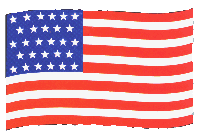
Six national flags have
flown over Texas since the first European exploration of
the region by Cortez in 1519. The six flags are:

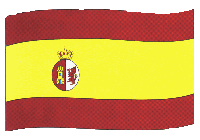
Texas Under Spain. 1519-1685; 1690-1821.
Spain was the first European nation to claim what is
now Texas, beginning in 1519 when Cortez was
establishing Spanish presence in Mexico, and Alonzo
Alvarez de Pineda mapped the Texas coastline. A few
shipwrecked Spaniards, like Alvar Nunez, Cabeza de Vaca,
and explorers such as Coronado, occasionally probed the
vast wilderness, but more than 100 years passed before
Spain planted its first settlement in Texas: Ysleta
Mission in present El Paso, established in 1681.
Gradually expanding from Mexico, other Spanish missions,
forts and civil settlements followed for nearly a
century-and-a-half until Mexico threw off European rule
and became independent in 1821. The red and yellow
striped Spanish flag after 1785 depicts a lion of Leon
and a castle of Castile on a shield surmounted by a
crown.

Texas Under France. 1685-1690
Planning to expand its base from French Louisiana,
France took a bold step in 1685, planting its flag in
eastern Texas near the Gulf Coast. Although claimed by
Spain, most of Texas had no Spanish presence at all; the
nearest Spanish settlements were hundreds of miles
distant. French nobleman Rene Robert Cavelier, Sieur de
la Salle, founded a colony called Fort St. Louis. But
the effort was doomed by a series of calamities:
shipwreck, disease, famine, hostile Indians, and
internal strife resulting in La Salle's murder by one of
his own company. by 1690, France's bold claim to Texas
had evaporated. The French flag features a host of
golden Fleurs-de-lis emblazoned on a field of white,
which was actually the French royal ensign for ships and
forts.

Texas Under Mexico. 1821-1836
For more than a decade after Mexico became
independent, hardy pioneers from the Hispanic south and
the Anglo north flowed into Texas. It was a frontier
region for both; Anglo Texans became Mexican citizens.
But divergent social and political attitudes began to
alienate the two cultures. The final straw: Mexican
General Santa Anna scrapped the Mexican federal
constitution and declared himself dictator. Texans
revolted and won their independence April 21, 1836, on
the battleground of San Jacinto near Houston. Mexico's
intricate flag pictures an eagle, a snake (an image from
pre-Columbian mythology) and cactus on bars of brilliant
green, white and red.

Texas as a Republic. 1836-1845
During nearly ten years of
independence, the Texas republic endured epidemics,
financial crises and still-volatile clashes with Mexico.
But it was during this period that unique accents of the
Texas heritage germinated. Texas became the birthplace
of the American cowboy; Texas Rangers were the first to
use Sam Colt's remarkable six-shooters; Sam Houston
became an American ideal of rugged individualism. Texas
joined the United States on December 29, 1845. The red,
white and blue Texas state flag with its lone star (the
same flag adopted by the republic in 1839) today flies
virtually everywhere: on government buildings, schools,
banks, shopping malls, and even on oil derricks.
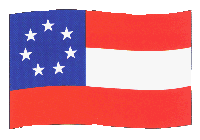
Texas in the Confederacy. 1861-1865
Sixteen years after Texas joined the union, the
American Civil War erupted. Gov. Sam Houston, urging
Texans to stay aloof or re-establish a neutral republic,
was driven from office. Texas cast its lot with the
doomed southerners, reaping devastation and economic
collapse as did all Confederate states. But two events
fixed Texas and Texans as somehow different in the
nation's eyes. First, Texas troops on Texas soil won the
final battle of the Civil War, not knowing the south had
capitulated a month earlier. Second, returning Texans
found a population explosion of wild Longhorns, sparking
the great cattle-trail drives that became American
legends. The first Confederate flag flown in Texas was
the South's national emblem, "The Stars and Bars" of the
Confederate States of America, although the
later-crossed Confederate battle flag is better known
today.
On joining the union, Texas became the 28th star on
the U.S. flag. Shrugging aside defeat and bitter
reconstruction after the Civil War, the offspring of
Texas pioneers marshaled their strengths to secure a
future based on determined self-reliance. First was the
fabled Texas Longhorn, providing beef for a burgeoning
nation. Newly turned topsoil on vast farm acreage
yielded bountiful crops. The 20th Century dawned with
the discovery of fabulous sources--gushers roaring in at
a place called Spindletop near Beaumont. By mid-century,
modern Texas industries were sprouting in a fertile
climate of advanced technology. Today under the
magnificent "Star Spangled Banner," Texas horizons
continue to expand, thrusting up to the limitless
reaches of outer space.